The ‘Open Goal’ project was funded by the Scottish Library Information Council, and ran between March-June 2026. The project was conceived by Ioannis Panayiotakis, librarian at Woodfarm and Eastwood High Schools in East Renfrewshire, whose research led him to understand the need for young adults to be specifically taught the skills and the precise vocabulary needed to express and regulate their feelings, in order to develop their broader emotional intelligence. As a librarian who was often asked by pupils for biographies of sporting heroes – stories of overcoming obstacles in a classic ‘Hero’s Journey’ style – he realised that using illustrative parallels from football would be the perfect medium for helping pupils to express their own feelings about success, failure, hopes and fears.
The first two introductory sessions took place on World Book Day as a general introduction to the S2 and S4 pupils at Woodfarm and Eastwood to the themes of the project, after which a smaller group of pupils from both schools took part in an in-depth series of four workshops to develop their emotional understanding and ability to express themselves through the medium of football.
The framework used to help young people understand and express emotions during this project was the RULER tool, developed at the Yale Center for Emotional Intelligence. It stands for five skills of emotional intelligence:
Recognizing: Observing changes in our own thoughts, energy, or physiology, as well as reading others’ facial expressions, body language, and tone of voice.
Understanding: Identifying the root cause of an emotion to see how it shapes our decisions and forecasts future behaviour.
Labelling: Connecting an emotional experience to a precise descriptive word. Building a precise vocabulary increases our accuracy in describing our inner world.
Expressing: Knowing how and when to display our emotions appropriately depending on the social context.
Regulating: Monitoring and modifying our emotional reactions to turn outrage into justice and fear into courage. To use feelings wisely.
(Brackett, 2019)
To help students build these skills, the project applied evidence-based and proven processes using Brackett’s Mood Meter, a tool built on decades of research.
The Mood Meter provides a matrix organized into four coloured quadrants based on degrees of energy and pleasantness:
Blue (Low Pleasantness, Low Energy): Feeling lonely, down, or sad.
Green (High Pleasantness, Low Energy): Feeling restful, calm, or content.
Red (Low Pleasantness, High Energy): Feeling angry, frustrated, or anxious.
Yellow (High Pleasantness, High Energy): Feeling excited, joyful, or proud.
Four sessions then took place across the two schools during March 2026, the first two run by Ioannis Panayiotakis with input from police officer and former professional footballer Jamie McQuilken, and the third and fourth session run by me with support from Ioannis, Jamie and school staff. The sessions covered the following:
Lesson 1: The Mood Meter and Emotional Awareness
Students learned to categorize feelings using the Mood Meter. They watched clips of the Scotland National Team to identify players’ emotions during high-stakes moments (e.g., how a player feels after being substituted) and borrowed new football books to read at home.
Lesson 2: Regulating Emotions and Reframing
Students practiced physical and mental tools to manage stress, such as Belly Breathing and Reframing (e.g., viewing a difficult school assignment as a chance to improve rather than a sign of failure). They were also introduced to the Best Self model.
Lessons 3 & 4: Creative Expression and Perspective-Taking
Students were led through activities and various football scenarios that helped them to think about and analyse both their own feelings and the feelings of others. They then drew on everything they’d learned during the project to write an original piece of prose or make a short recording of their thoughts.
[combo pic from some of the sessions]
During session 3, pupils watched a clip of a high-stakes penalty-shootout and imagined the feelings of both the striker and goalkeeper. They recorded these feelings in short sentences which were turned into ‘Hope and Failure’ and ‘Hope and Success’ poems. The poems were then run through an AI-music generator to create songs describing these feelings.
Woodfarm Poems:
Woodfarm ‘Hope and Failure’ song:
Woodfarm ‘Hope and Success’ song:
Eastwood Poems:
Eastwood ‘Hope and Failure’ song:
Eastwood ‘Hope and Success’ song:
The pupils produced a wide range of expressive pieces in both written and oral form, and funding from the School Library Improvement Fund (SLIF) allowed both schools to purchase football-related books and football strips to thank the participants.
Galleries of some of the session photos can be found here:
This pilot project was wrapped up in June 2026 with a special evening that gave parents of the project’s participants the chance to hear about the aims, delivery and results of the Open Goal project from Ioannis, Jamie and myself.
An Open Goal project booklet is currently being written and will be available to download here in the near future. It will contain all of the project’s aims, objectives, content and lessons plans, which will allow teachers and educators to run their own emotional intelligence projects with their pupils.


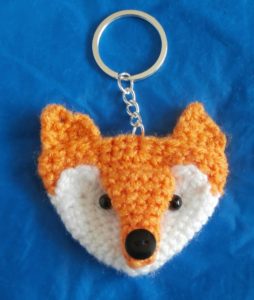 Would you like to help raise funds for the Scottish Refugee Council? If you buy one of my specially crocheted fox keyrings from Etsy, then all money will be donated to the Scottish Refugee Council to support their work helping those who have come to Scotland in search of a safer home.
East Renfrewshire Schools – Open Goal Project
The ‘Open Goal’ project was funded by the Scottish Library Information Council, and ran between March-June 2026. The project was conceived by Ioannis Panayiotakis, librarian at Woodfarm and Eastwood High Schools in East Renfrewshire, whose research led him to understand the need for young adults to be specifically taught the skills and the precise vocabulary needed to express and regulate their feelings, in order to develop their broader emotional intelligence. As a librarian who was often asked by pupils for biographies of sporting heroes – stories of overcoming obstacles in a classic ‘Hero’s Journey’ style – he realised that using illustrative parallels from football would be the perfect medium for helping pupils to express their own feelings about success, failure, hopes and fears.
The first two introductory sessions took place on World Book Day as a general introduction to the S2 and S4 pupils at Woodfarm and Eastwood to the themes of the project, after which a smaller group of pupils from both schools took part in an in-depth series of four workshops to develop their emotional understanding and ability to express themselves through the medium of football.
The framework used to help young people understand and express emotions during this project was the RULER tool, developed at the Yale Center for Emotional Intelligence. It stands for five skills of emotional intelligence:
(Brackett, 2019)
To help students build these skills, the project applied evidence-based and proven processes using Brackett’s Mood Meter, a tool built on decades of research.
The Mood Meter provides a matrix organized into four coloured quadrants based on degrees of energy and pleasantness:
Four sessions then took place across the two schools during March 2026, the first two run by Ioannis Panayiotakis with input from police officer and former professional footballer Jamie McQuilken, and the third and fourth session run by me with support from Ioannis, Jamie and school staff. The sessions covered the following:
Students learned to categorize feelings using the Mood Meter. They watched clips of the Scotland National Team to identify players’ emotions during high-stakes moments (e.g., how a player feels after being substituted) and borrowed new football books to read at home.
Students practiced physical and mental tools to manage stress, such as Belly Breathing and Reframing (e.g., viewing a difficult school assignment as a chance to improve rather than a sign of failure). They were also introduced to the Best Self model.
Students were led through activities and various football scenarios that helped them to think about and analyse both their own feelings and the feelings of others. They then drew on everything they’d learned during the project to write an original piece of prose or make a short recording of their thoughts.
[combo pic from some of the sessions]
During session 3, pupils watched a clip of a high-stakes penalty-shootout and imagined the feelings of both the striker and goalkeeper. They recorded these feelings in short sentences which were turned into ‘Hope and Failure’ and ‘Hope and Success’ poems. The poems were then run through an AI-music generator to create songs describing these feelings.
Woodfarm Poems:
Woodfarm ‘Hope and Failure’ song:
Woodfarm ‘Hope and Success’ song:
Eastwood Poems:
Eastwood ‘Hope and Failure’ song:
Eastwood ‘Hope and Success’ song:
The pupils produced a wide range of expressive pieces in both written and oral form, and funding from the School Library Improvement Fund (SLIF) allowed both schools to purchase football-related books and football strips to thank the participants.
Galleries of some of the session photos can be found here:
Woodfarm Session 3
Eastwood Session 3
Eastwood Session 4
This pilot project was wrapped up in June 2026 with a special evening that gave parents of the project’s participants the chance to hear about the aims, delivery and results of the Open Goal project from Ioannis, Jamie and myself.
You can see some highlights of the evening in the gallery here
An Open Goal project booklet is currently being written and will be available to download here in the near future. It will contain all of the project’s aims, objectives, content and lessons plans, which will allow teachers and educators to run their own emotional intelligence projects with their pupils.